Life through fence
- 10.03.2008, 18:55
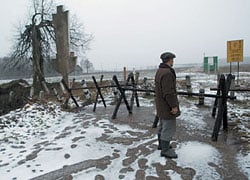
Belarusian-Lithuanian village Pitskuny-Norvilishkes is a place where a border between the European Union and former USSR lies on people. Literary, no metaphors.
Here stays a village. It looks like one village, but there are two in fact. The village is divided between Belarus and Lithuania. It is called Pitskuna in Belarus and Norvilishki in Lithuania. Or, officially, with “s” at the end, Norvilishkes, but Belarusians, who live there, are the same as in Pitskuny, they don’t speak or read Lithuanian. They speak Belarusian-Russian language mixture, Belarusian, a little Polish. Common language, under Soviet rule – common kolkhoz, common fields, common cemetery. An ordinary story - in 1990 Lithuanian border guards came with maps and establish a border; next year Belarusian border guards came. It was at first agreed to ruin the houses and sheds staying on the border line, for example, Anton Lentsynovich’s house is the last outpost before the European Union. As it was found later, the frontier was laid through Lithuanian, Norvilishki houses, too. So it was decided not to discredit themselves and not to ruin anyothing. Lentsynovich had just to build gates from the other side so that he could drive a tractor to his yard. On place of former gates an iron border fence was constructed.
Near Anton’s house and the fence, 20 meters inside Lithuania a big castle, present hotel stays. An exclusive suggestion: a guide in a sutan comes with tourists to the border fence. They make cell phones pictures. The guide-monk says something in Lithuanian. Every word is heard on the Belarusian territory, it is even possible to understand: kontrabandas, Lukashenkas…
Leakadziya Hardzievich lives in Norvilishki. Her husband left for Ashmyany, Belarus, last year – he found a job there. Leakadziya assures there is no work in Norvilishki. After Lithuania joined the European Union, both wife and husband need visas to visit each other. He has a Belarusian passport, she has a Lithuanian one. “I can go wherever I’d like, to Europe. But not to Belarus. Well, why should I pay for my husband? Damn him!” Leakadziya gets exited. Family tragedy is a usual thing. No one has money for visa – nor fifty Pitskuny dwellers, neither Norvilishki ones. Most of them are pensioners, they have nothing in budgets.
Until recently dwellers of frontier territories could pay 5 dollars for visas, and Pitskuny inhabitants were granted free visas. It was until Lithuania joined the Schengen Zone, until this year. There is no agreement between Belarus and the EU on cheap visas – both for ordinary citizens and inhabitabts of frontier territory. A single entry visa to Lithuania costs 60 euro, a multiple entry one for a year costs 120 euro. But none of Pitskuny dwellers has received a visa yet even for this fantastic for the village money. Pitskuny inhabitants must go to the district center to collect all necessary documents for visa application. And then one should go to a consulate in Minsk. Insurance and other expanses amount to 50 dollars and more.
The travel expenses should also be taken into account. But last way to the cemetery costs even more for Pitskuny dwellers. Pitskuny and Norvilishki have a common cemetery, situated on the Lithuanian territory. All graves are family. Firstly, one needs to collect documents in Belarus, get permission for funeral in Lithuania, pay for road and entrepreneur (everything is in Lithuanian). Then one should book a vehicle, a driver must have a Lithuanian visa.
And then one should make a two-hour trip: simplified border crossing to the Schengen one is open only on holidays. No exceptions for the dead. So one needs to make 100-kilometer way around to bury a deceased behind the fence at the distance 50 meters from a house.
So, 100 kilometers and 300 dollars for a driver as minimum, and plus payment for documents - total at least 500 dollars. Pitskuny dwellers know that “it’s cheaper to live.”
Franek Mikhalouski is a Lithuanian, from Norvilishki, an experienced “kontrabandas” : Franek paid an unsuccessful visit to his sister in Potskuny – practically through a hole in the fence, without documents. Mikhalouski was caught and given 5 months in Belarusian prison and prohibited entry Belarus after serving the term. “Husband and wife are buried here” Franek shows the new-made graves. “At first the husband died, children began to prepare documents for funeral, and the wife died the next day. They were taken over the border together.”
“I was looking through the fence at the funeral of my father-in-law,” 50-year-old Viktar Yanovich from Belarusian Pitskuny reminds. “I carried a wreath to the fence, but wasn’t allowed to pass it. I became so angry that I thought to throw it away. But I hung it on our side.”
A church is situated near the cemetery and the castle. The services are conducted in Polish, Latin, and Lithuanian. A clergyman is an old Lithuanian, a special bus drives old woman from neighbouring countries to a mass. Until last autumn believers from Pitskuny came to the border fence on religious holidays – to the place where the fence is close to the cemetery wall. The clergyman spoke with worshipers over the fence, heard confessions, gave communion. But this spiritual loophole was sealed at the beginning of November – on All Saints’ Day. Not by Lithuanians, but by Belarusian border guards: allegedly it is forbidden to gather in groups near a border fence, it is violation of frontier regime. The Christmas mass was conducted at 100-meter distance from the restricted area. Easter is coming, a holiday mass will apparently be conducted in the same regime. Regime, which is familiar to those who are divided by an iron... not even curtain, just fence.